Article
Homeschooling vs. Traditional Schooling
Homeschooling vs. Traditional Schooling: How to Choose What’s Actually Best for Your Family
If you’ve found yourself staring at the ceiling at 2:00 AM wondering if you should pull your kid out of school—or, conversely, if you’re a homeschool parent wondering if life would be easier if a school bus just picked them up every morning—you are definitely not alone.
Choosing how to educate your kids is one of those massive, deeply personal parenting decisions. The internet loves to make it feel like a turf war, but the truth is pretty boring: neither option is inherently better than the other. It all comes down to your family’s unique lifestyle, your child’s personality, and your own sanity boundaries.
Let’s skip the clinical pros-and-cons lists and look at how these two paths actually play out in real life.
1. The Daily Rhythm: Freedom vs. Structure
The Homeschool Reality
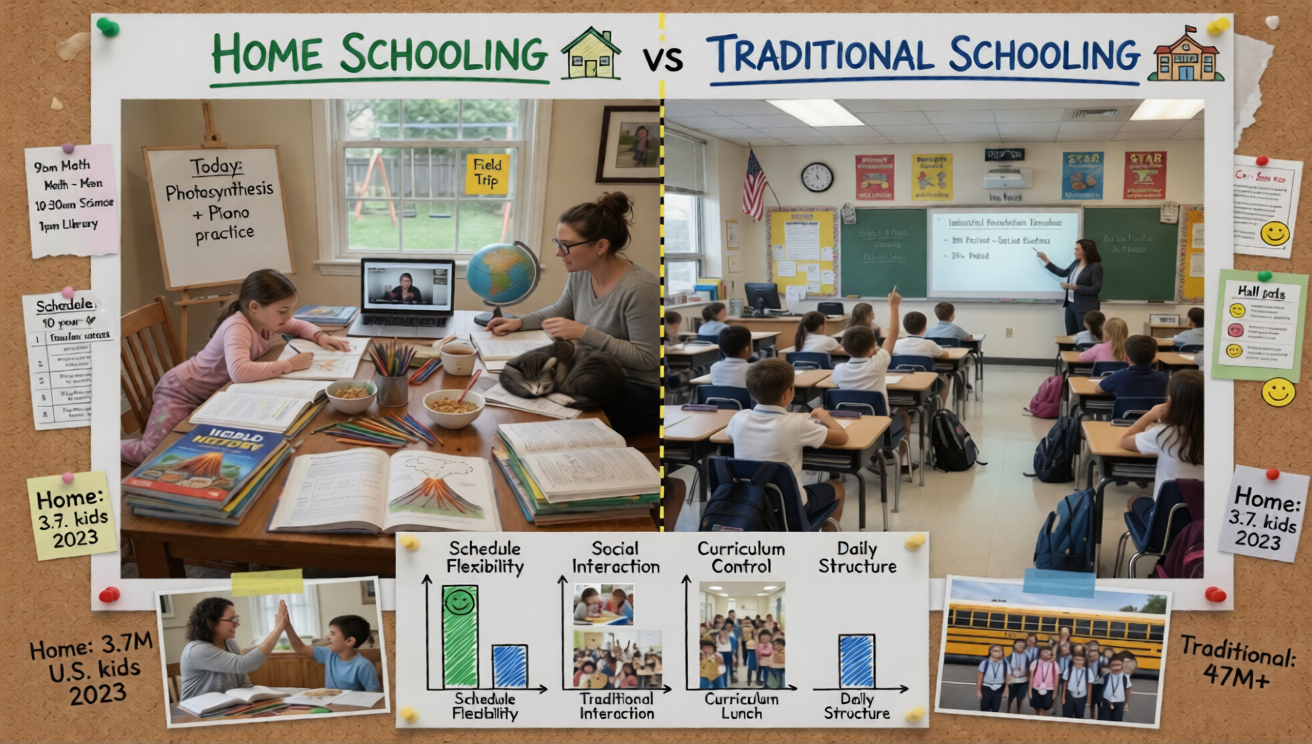
Homeschooling means throwing the traditional clock out the window. If your kid is a night owl who does their best thinking at 10:00 PM, or if they breeze through a week’s worth of math in two days and want to spend the rest of the week reading about marine biology—you can let them. You can travel in October when flights are cheap, and the world becomes your classroom.
The Catch: That freedom requires serious self-discipline. Without a school bell ringing, it is incredibly easy for "flexible" to turn into "we haven't done math in three weeks."
The Traditional School Reality
There is a massive comfort in the school routine. The bus arrives at 7:30 AM, they are occupied all day by professionals, and they come home at 3:00 PM. This structure is fantastic for kids who thrive on predictability, and let's be honest, it's essential for parents working standard 9-to-5 jobs.
The Catch: Your family schedule is entirely locked into the school calendar. Missing a week for a family trip means playing a stressful game of homework catch-up.
2. The "S-Word": Socialization
Let’s address the elephant in the room. Whenever you tell someone you’re thinking about homeschooling, the first question is always: “But what about socialization?”
In Traditional School: Socialization is built into the fabric of the day. Kids are thrown into a diverse melting pot of peers. They learn how to navigate cliques, deal with difficult personalities, share space, and find their crowd. It’s a crash course in real-world social dynamics.
In Homeschooling: Socialization doesn’t just happen; it has to be curated. Homeschooled kids aren't locked in closets—they join homeschool co-ops, sports leagues, theater groups, and scouts. The upside? They often learn to talk to adults and younger kids with incredible confidence because they aren't segregated by age all day. The downside? You, the parent, are now the chauffeur and social coordinator.
3. The Toll on You (Time, Money, and Energy)
Let’s get brutally honest for a second about what each choice demands from you as a parent.
The Vibe | Homeschooling | Traditional Schooling |
Your Role | You are the teacher, principal, and guidance counselor. | You are the project manager, homework helper, and cheerleader. |
The Wallet | You buy the curriculum, the science kits, and the field trip tickets. | Public school is mostly free (minus the endless fundraisers and supply lists); private school is a major investment. |
Your Free Time | It's practically non-existent, especially in the early years. | You get a predictable block of time every day to work, rest, or run errands. |
4. Academic Style and Special Needs
Every child learns differently, and this is often the ultimate deciding factor for families.
If your child has learning differences like ADHD, dyslexia, or severe anxiety, homeschooling allows you to tailor the environment perfectly to them. No sensory overload, no being forced to sit still for six hours, and no shame in moving at their own pace.
On the flip side, traditional schools have resources that are hard to replicate at home. They have certified special education teachers, speech therapists, sports facilities, high-tech science labs, and counselors whose entire jobs are dedicated to student success.
The Verdict: Trust Your Gut
Here is the secret nobody tells you: Your choice isn't permanent.
You can homeschool for kindergarten and send them to public school for first grade. You can utilize traditional schools until middle school gets rocky, and then pull them home.
If you have the time, the patience, and a deep craving to customize your child's worldview and learning pace, homeschooling is a beautiful adventure.
If you love your job, value a structured routine, and want your child to learn to thrive in a large, diverse peer environment, traditional schooling is a fantastic tool.
Take a deep breath. Look at the kid sitting across from you, look at your bank account and your mental health, and make the choice that brings your home the most peace. You've got this.