Article
How AI Makes Learning More Effective and Engaging
How AI Makes Learning More Effective and Engaging
Meta Title: How AI Makes Learning More Effective and Engaging | AI in Education Guide
Meta Description: Discover how Artificial Intelligence is making learning more personalized, interactive, and engaging for students through AI tutors, adaptive learning, real-time feedback, and intelligent education platforms.
Introduction
The way we learn has changed dramatically over the past decade. Traditional classrooms, textbooks, and one-size-fits-all teaching methods are being enhanced by Artificial Intelligence (AI), creating learning experiences that are smarter, more personalized, and highly engaging.
Today's students expect instant answers, interactive lessons, and flexible learning environments. AI meets these expectations by adapting to each learner's needs, providing real-time guidance, and making education accessible anytime and anywhere.
Rather than replacing teachers, AI serves as an intelligent learning companion that helps students understand concepts faster, stay motivated, and achieve better academic results.
In this article, we'll explore how AI is making learning more effective and engaging for students of all ages.
What Is AI-Powered Learning?
AI-powered learning uses Artificial Intelligence to deliver personalized educational experiences based on each student's learning style, pace, interests, and performance.
Unlike traditional teaching methods, AI can continuously analyze student progress and adjust learning materials to match individual needs.
This creates a learning experience that is:
Personalized
Interactive
Flexible
Data-driven
Accessible
Continuously improving
The goal is simple: help every learner succeed.
Why Traditional Learning Has Limitations
In a typical classroom, one teacher may be responsible for teaching dozens of students with different abilities and learning styles.
Some students learn quickly, while others need more time and additional explanations.
Common challenges include:
Limited individual attention
Fixed learning pace
Delayed feedback
Lack of personalized support
Difficulty identifying learning gaps
Reduced student engagement
AI helps overcome these challenges by providing individualized learning support.
1. Personalized Learning for Every Student
One of AI's greatest strengths is personalization.
Instead of giving every student the same lesson, AI creates customized learning paths based on:
Learning speed
Previous performance
Strengths
Weaknesses
Interests
Learning preferences
If a student struggles with algebra, AI recommends additional practice before introducing more advanced topics.
If another student masters a concept quickly, AI automatically moves them forward.
This ensures that every learner progresses at the right pace.
2. Instant Answers and 24/7 Support
Learning doesn't stop when school ends.
Students often have questions while studying at home, preparing for exams, or completing assignments.
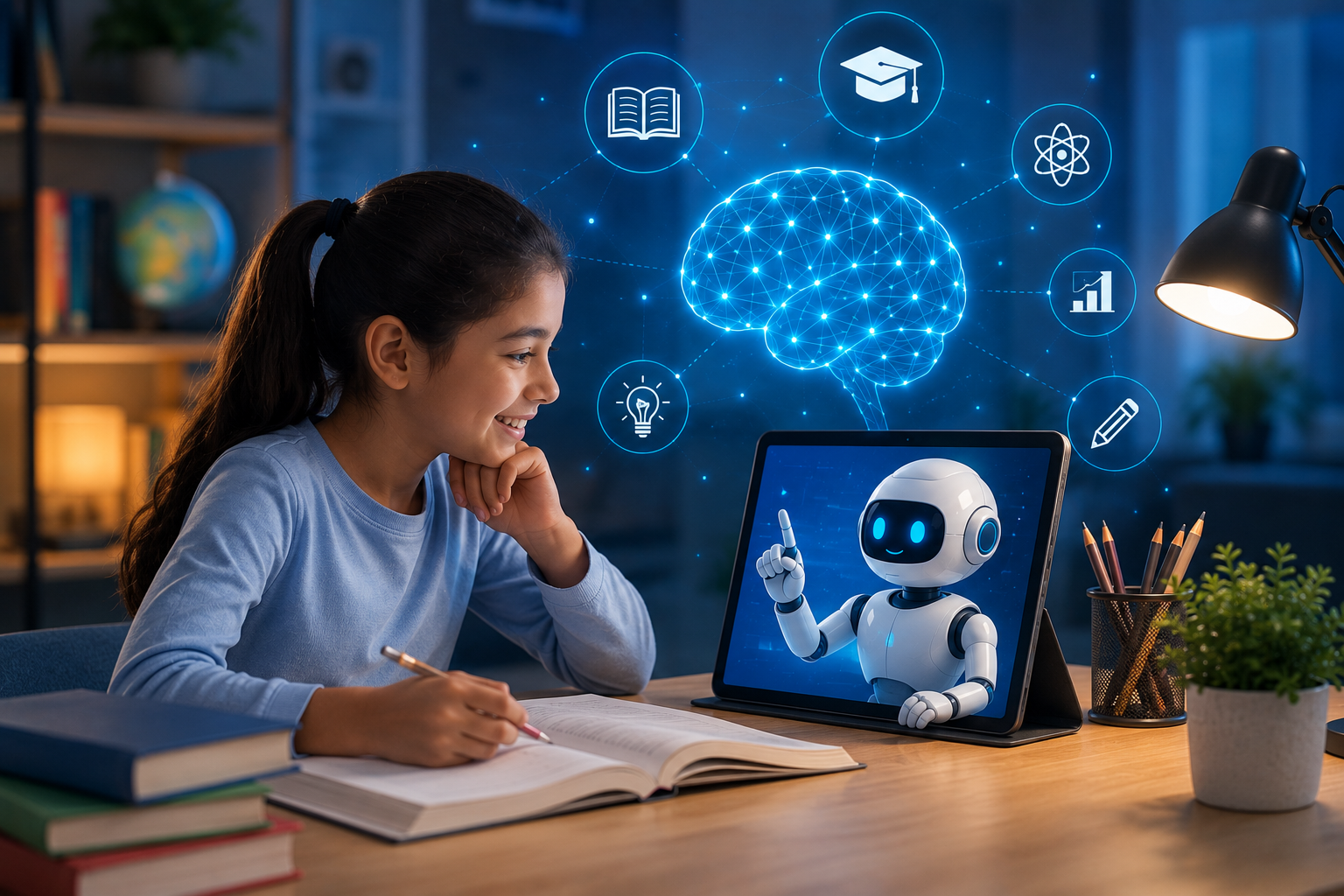
AI Tutors provide:
Instant explanations
Step-by-step solutions
Subject-specific guidance
Practice questions
Homework assistance
Because AI is available 24/7, students never have to wait until the next class to resolve their doubts.
3. Interactive Learning Experiences
Students learn more effectively when they actively participate in the learning process.
AI makes education interactive through:
Conversational learning
Voice-based tutoring
Educational games
Interactive quizzes
Simulations
Visual explanations
Personalized challenges
Interactive learning keeps students curious and improves long-term knowledge retention.
4. Real-Time Feedback
Traditional assessments often provide feedback days or weeks after an assignment is completed.
AI changes this by delivering immediate feedback.
Students instantly learn:
Which answers are correct
Why mistakes occurred
How to improve
Which topics need revision
Immediate feedback helps learners correct mistakes before they become habits.
5. Adaptive Learning Technology
Adaptive learning systems continuously adjust lesson difficulty based on student performance.
For example:
If a learner answers several questions correctly, AI introduces more challenging material.
If the learner struggles, AI simplifies explanations and recommends revision.
This creates an optimal balance between challenge and confidence.
6. Increased Student Motivation
AI makes learning enjoyable by incorporating elements that keep students engaged.
Examples include:
Achievement badges
Learning milestones
Personalized progress reports
Interactive challenges
Daily learning goals
Positive reinforcement
Seeing measurable progress motivates students to continue learning consistently.
7. Better Learning Through Data
Every learning session generates valuable insights.
AI analyzes data such as:
Time spent studying
Quiz performance
Learning consistency
Frequently asked questions
Revision habits
Subject mastery
Using this information, AI provides smarter recommendations that improve learning outcomes over time.
8. Learning in Multiple Languages
Language should never be a barrier to education.
Modern AI learning platforms support multiple languages, allowing students to:
Learn in their preferred language
Switch between languages during lessons
Improve pronunciation
Practice speaking skills
Understand difficult concepts more easily
This makes education more inclusive and accessible to learners around the world.
9. Helping Teachers Focus on Teaching
AI also benefits educators by reducing repetitive administrative tasks.
Teachers can use AI to:
Grade quizzes automatically
Generate lesson plans
Track student performance
Identify struggling learners
Create personalized assignments
Monitor classroom progress
With routine tasks automated, teachers have more time to mentor, inspire, and support students.
10. Preparing Students for the Future
AI is not only improving today's classrooms—it is preparing students for tomorrow's careers.
Through AI-powered learning, students develop:
Critical thinking
Problem-solving
Digital literacy
Creativity
Collaboration
Adaptability
Data interpretation
These future-ready skills are becoming increasingly valuable across every industry.
Challenges to Consider
While AI offers tremendous benefits, it should be implemented responsibly.
Educational institutions should focus on:
Protecting student privacy
Using secure AI platforms
Avoiding overdependence on technology
Maintaining human interaction
Ensuring equal access to digital resources
The most successful learning environments combine AI with experienced teachers.
The Future of AI in Learning
The future of education is becoming more intelligent and immersive.
Emerging innovations include:
AI-powered virtual tutors
Digital teacher avatars
Voice-based learning assistants
Augmented Reality (AR) classrooms
Virtual Reality (VR) learning experiences
Emotion-aware AI tutors
Predictive academic coaching
Personalized career guidance
These technologies will make education more engaging, inclusive, and effective than ever before.
Conclusion
Artificial Intelligence is transforming education by making learning more personalized, interactive, and engaging. Students receive customized support, instant feedback, and the freedom to learn at their own pace, while teachers gain powerful tools to enhance instruction and better understand student needs.
The future of education is not about choosing between teachers and technology. It is about combining the expertise of educators with the intelligence of AI to create richer learning experiences for every student.
As AI continues to evolve, it will play an increasingly important role in helping learners build knowledge, confidence, and the skills needed to succeed in a rapidly changing world.
Frequently Asked Questions (FAQs)
1. How does AI improve learning?
AI improves learning by personalizing lessons, providing instant feedback, identifying knowledge gaps, recommending study plans, and offering 24/7 academic support.
2. Can AI replace teachers?
No. AI is designed to support teachers by automating routine tasks and providing personalized assistance, while teachers continue to guide, mentor, and inspire students.
3. What are the biggest benefits of AI in education?
Some of the biggest benefits include personalized learning, adaptive assessments, instant feedback, better student engagement, improved academic performance, and learning anytime, anywhere.
4. Is AI suitable for young learners?
Yes. Age-appropriate AI learning platforms can provide interactive lessons, educational games, and personalized guidance that support children while complementing parental and teacher involvement.
5. What is the future of AI-powered learning?
The future includes intelligent tutors, multilingual learning assistants, immersive AR/VR classrooms, predictive learning analytics, and highly personalized educational experiences that adapt to every learner's needs.
Final Thoughts
AI is transforming education from a one-size-fits-all system into a personalized journey where every student can learn in the way that suits them best. By making learning more engaging, accessible, and effective, AI is helping educators and learners unlock new possibilities—and shaping the future of education for generations to come.