Article
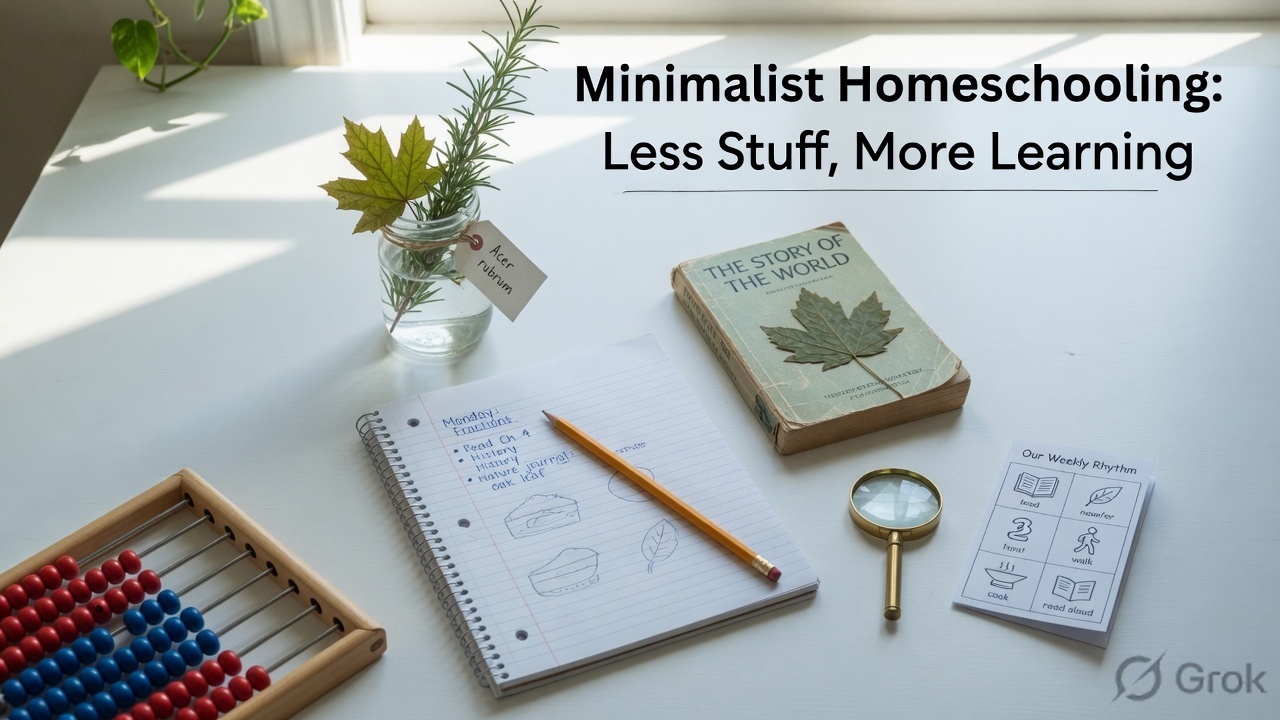
Minimalist Homeschooling: Less Stuff, More Learning
Minimalist Homeschooling: Less Stuff, More Learning
In a world overflowing with flashy curricula, workbooks, manipulatives, and educational gadgets, minimalist homeschooling offers a refreshing alternative: focus on what truly matters — deep learning, strong family bonds, and real skill development — while letting go of the excess.
If you're feeling overwhelmed by homeschool supplies, cluttered spaces, or an overly packed schedule, minimalist homeschooling might be exactly what your family needs.
What Is Minimalist Homeschooling?
Minimalist homeschooling isn't about doing the absolute bare minimum. It's about intentional simplicity — removing distractions (physical, mental, and time-related) so that real learning can flourish.
It means:
Fewer books and resources, but better ones.
A calm, uncluttered learning space.
A simple daily rhythm instead of a rigid, overloaded timetable.
Prioritizing quality experiences over quantity of materials.
Why Choose Minimalist Homeschooling?
Less overwhelm
for both parents and kids.
More time for free play, nature, reading, and deep conversations.
Better focus and retention.
Saves money (very important for many Indian families).
Creates a peaceful home environment.
Teaches children the value of simplicity and contentment.
Many parents report that when they reduced "stuff," their children actually learned more because they weren't constantly switching between activities.
Step 1: Declutter Your Homeschool Space
Start here — physical clutter creates mental clutter.
Practical decluttering tips:
Go through every cupboard and shelf. Ask: "Are we actually using this right now?"
Keep only what serves your current season (e.g., current grade-level books).
Use simple storage: One basket for art supplies, one shelf for core books.
Household items work great — beans for counting, sticks for geometry, kitchen scale for measurements.
Digitize where possible: PDFs, Khan Academy, NCERT online books.
Indian context tip: Many families in apartments (like in Greater Noida) benefit hugely from this. A dedicated corner with a small table, floor mats, and minimal shelves works beautifully.
Step 2: Simplify Your Curriculum & Resources
You don’t need 10 different programs.
Core minimalist toolkit:
NCERT books
(free downloads from ncert.nic.in) — excellent quality for most subjects.
Khan Academy
— completely free, covers Math, Science, and more.
A good set of library books or classic literature.
One or two quality workbooks if needed.
Nature, kitchen, and real-life experiences.
Recommended free/low-cost resources (2026):
Easy Peasy All-in-One Homeschool (printable)
Ambleside Online (Charlotte Mason style)
YouTube channels for explanations (in English or Hindi)
Local library membership
Focus on mastery over coverage. It's better for a child to deeply understand fractions than to rush through 15 topics superficially.
Step 3: Create a Simple Daily Rhythm
Minimalist schedules often look like this:
Morning Time
(1 hour): Prayer/affirmations, reading aloud, poetry, or discussion.
Core Academics
(2-3 hours): Math + Language + one other subject.
Afternoons
: Outdoor time, interest-led learning, chores, or creative play.
Evenings: Family time, board games, or more reading.
Keep afternoons relatively free. White space in the day is where creativity and deep thinking happen.
Step 4: Focus on What Matters Most
Prioritize these areas:
Reading
(aloud and independently)
Math
(daily practice)
Writing
(narration, journaling)
Life skills & character
(chores, cooking, responsibility)
Nature & movement
(daily outdoor time)
Everything else can be interest-led or added seasonally.
Real-Life Example (Indian Family)
Imagine a family in Noida: They use NCERT books for structure, Khan Academy for Math practice, borrow library books weekly, and spend afternoons in the park or doing simple science experiments with kitchen items. No expensive manipulatives, no 8-subject timetable. Their kids are calm, curious, and actually enjoy learning.
Common Challenges & Solutions
Challenge | Minimalist Solution |
Fear of "not doing enough" | Trust the process + track real progress |
Relatives' pressure | Share results and child’s happiness |
Storage in small homes | Vertical storage + digitization |
Multiple children | Multi-age learning (read alouds, projects) |
Final Thoughts
Minimalist homeschooling isn’t about deprivation — it’s about freedom. Freedom from comparison, from consumerism, and from burnout. When you remove the unnecessary, you make space for what’s truly valuable: connection, curiosity, and meaningful growth.
Start small. This week, declutter just one shelf or remove one subject from your timetable. Observe how it feels.
Less stuff really can lead to more learning — and more joy.